


|
|
|---|


Showing posts with label migration. Show all posts
Showing posts with label migration. Show all posts
Friday, March 18, 2011
An interesting opinion piece on the rapidly growing Hispanic population in the US.
For the original article visit: http://www.cnn.com/2011/OPINION/03/18/navarrette.hispanic.census/index.html
Is America becoming a
Hispanic country?
March 18, 2011 10:15 a.m. EDT
(CNN) -- The United States is becoming an Hispanic country. And it's happening much faster than anyone expected.
According to an analysis of newly released 2010 U.S. Census data by the Pew Hispanic Center, the Hispanic population in the United States is growing more quickly and more dramatically than demographers had estimated.
In the 33 states for which data has been released so far, there are almost 600,000 more Hispanics than previously thought. Twenty-eight states had more Hispanics than expected. And, while the current count is 38.7 million Hispanics, there is still data coming from 17 states, making it likely that the final figure could surpass 55 million, or 17% of the U.S. population.
What is really interesting is that this "Hispanicization" of America is most noticeable in states that are not typically thought of as being places where Hispanics live.
The real story isn't what's happening in Texas, California, Florida or New York, which have long been home to significant numbers of Hispanics. It's about the demographic changes in states such as Alabama, Louisiana, Kansas and Maryland, where Hispanics are a relatively new commodity -- and the accommodations that have to be made between new arrivals and longtime residents.
One day soon, Hispanics will help define the worlds of media, politics, commerce, fashion, music, entertainment, sports and science. There will be no turning back.
But you knew that already. Maybe your first hint was the Latina models on magazine covers. Or that salsa is more popular than ketchup. Or the Spanish-language billboards you see on rural highways. Or that some members of Congress gather weekly for Spanish lessons.
Or maybe you figured out that the Hispanic population in the United States was exploding when you saw the quixotic efforts of some to stop the trend by cracking down on illegal immigration and -- for an encore -- trying to limit legal immigration as well.
Most immigrants to the United States, legal and illegal, come from Mexico and the rest of Latin America. But in states such as Arizona, Texas, Colorado and New Mexico, you also have Hispanic families that can trace their American roots back hundreds of years.
Still, for many Americans, changing demographics isn't cause for celebration. Rather, it's cause for alarm. It brings a sense of fear, anxiety and desperation. They know enough to know that the country in which they grew up is changing, and they'll do whatever they can to reverse those changes and return the cultural landscape to what it used to be.
In fact, Hispanics have become so accustomed to this sort of reaction that I know many of them who actually dread the census and all the related media coverage. Every 10 years, there is the possibility of a backlash. For Hispanics, being counted is a mixed bag. They gain numbers and prominence, but they also have to contend with resistance and hostility from those who feel threatened.
This partly explains what happened in Arizona, where a surging Hispanic population so panicked the state's residents that they began pushing lawmakers to pass immigration-related bills aimed at making the state less hospitable to illegal immigrants. This wasn't about reaffirming the rule of law. It was about returning Arizona to what it looked like 50 or 60 years ago, when the number of Hispanics in the state was much smaller than it is now.
It seems to have worked. The analysis of census data done by the Hispanic Pew Center shows that in Arizona, the number of Hispanics came in at 1.9 million, or 180,000 fewer than expected.
But many of those immigrants had simply moved on to other states. This approach would not be much of a national strategy; besides, who is to say that many of those people won't return to Arizona when the economy improves or some of these excessively punitive laws are dismantled.
Ultimately, you can't fight demographics. Hispanics are already here, and most of them aren't going anywhere. Instead of wishing otherwise, Americans would be better off accepting this new reality. While they're at it, they should acknowledge the positive impact to their communities and their country of having a growing population of people who are, by nature, conservative, hardworking, optimistic, patriotic and entrepreneurial. Hispanics aren't a threat to the United States; they're an essential component.
Visit any military cemetery in the United States and count the Spanish surnames. You'll see that Hispanics have already contributed so much to this country. And, in the decades to come, they and their children stand ready to contribute so much more -- if we put aside our prejudice and let them. That's the path to a better country.
Friday, March 4, 2011
Way back in the beginning of February I spent the long weekend in Puebla with friends.
Saturday we went to Puebla -- the capital of the state (to see post from my visit with my parents to Puebla click here). Our "tour guide" for the weekend (Chang, a new friend who is from Puebla and was kind enough to invite us to stay with his family) introduced us to cemitas -- a Puebla standard. It's a (huge) sandwich differentiated mostly for the type of bread (sesame seeded egg roll according to wikipedia?).
Saturday we went to Puebla -- the capital of the state (to see post from my visit with my parents to Puebla click here). Our "tour guide" for the weekend (Chang, a new friend who is from Puebla and was kind enough to invite us to stay with his family) introduced us to cemitas -- a Puebla standard. It's a (huge) sandwich differentiated mostly for the type of bread (sesame seeded egg roll according to wikipedia?).
 |
| enjoying the (huge!) cemita |
From there we spent some time in the artisans market and then wandered around downtown Puebla.


Coming down from the hill/mountain, we continued our tour of Atlixco.

We went back to Chang's house and enjoyed some more delicious food and a great view of Popocateptl at sunset.
We watched the Superbowl -- it wasn't the same without the commercials! I also realized my vocabulary to talk about American Football is rather limited. We left during the 3rd quarter to go to the bus station, but were able to watch more at the terminal and got the final score on the bus.
For me, one of my favorite aspects of the weekend (besides exploring Atlixco of course) was spending time with the family -- Chang's mom and niece and nephew. They were so sweet, welcoming, generous -- all the best of the Mexican stereotype. It was interesting to see and hear about the migration experience from those that stay behind. I have worked with migrants in the US and studied migration, but hadn't really seen it "up close" on this side of the border. Chang's niece and nephew live with their grandmother because their mom lives and works in the US. They've grown up with their grandmother and know her better than their biological mother. They even call her mom. Along with other stories, it was an interesting first-hand view of how migration affects families.
 |
| Puebla was originally called Puebla de los Angeles and is sometimes referred to as Angelópolis |
 |
| So. Many. Balloons. (Zócalo, Cathedral in the background) |

 |
| Municipal Palace |

 |
| church |
 |
| church |
That evening we headed to Atlixco, which is the third-largest community in Puebla. We met Chang's family and enjoyed a delicious meal, including home-made mole! Puebla is known for it's food, but his mom's cooking was definitely the best I've had of the various Puebla staples. Case in point: From my previous experiences I would probably describe mole as interesting, but his mom's mole was delicious!
Sunday morning we had tamales and atole and/or coffee for breakfast with his family. I had a sweet tamal, but there were also tamales with rajas or mole. Once again, the atole his mom made was the best I've tasted so far.
From there, we set out to explore Atlixco. On our way into town we saw:
 |
| A cat with clothes.... |
 |
| Cutting flowers, with the Popocatepetl volcano in the background. Atlixco (and Puebla in general?) produces a lot of flowers |
Chang's mom bought Tati and I ceramic pots to cook with, similar to the type she uses. We climbed up to Capilla de San Miguel, a chapel on top of a large hill (small mountain?) to get a view of Atlixco and surrounding areas.
 |
| view of Atlixco. Climbing up to the Capilla de San Miguel (with the pots his mom bought us) |

 |
| view of Popocatepetl in the background |
 |
| view of Popocatepetl |
 |
| Plaza of the Dance of the Huey Atlixcayotl (like the Voladores de Papántla). Since it's high up on the hill, "flyers" can be seen from all around down below |
 |
| flowers on a cactus |


 |
| view of Atlixco |
 |
| Capilla de San Miguel |
 |
| Atlixco |
 |
| Atlixco |
Coming down from the hill/mountain, we continued our tour of Atlixco.
 |
| Franciscan Convent, built around 1550 |
 |
| Franciscan Convent, built around 1550 |
 |
| Franciscan Convent, built around 1550 |
 |
| Temple of the Third Order |
 |
| selling flowers in the Zócalo |
 |
| mural of the history of Atlixco |
 |
| mural of the history of Atlixco (ceiling) |
 |
| mural of the history of Atlixco |
 |
| mural of the history of Atlixco The tree where the eagle landed, which was the sign to build the city there. We saw the actual tree earlier in the day (the spring has dried up) but I didn't get a photo. |
 |
| mural of the history of Atlixco |

 |
| mural of the history of Atlixco Day of the Dead and Independence Day |
 |
| mural of the history of Atlixco |
 |
| talavera |
 |
| mural of the history of Atlixco |
 |
| Mural of Liberation from the Oppression Porfirio Diaz's Regime |
 |
| Mural of Liberation from the Oppression Porfirio Diaz's Regime |
 |
| church |
 |
| Zócalo |
 |
| Zócalo |
 |
| lime nieve with red wine |
 |
| enjoying our nieve and sorbet and (don't remember what its called, but its sweet and made out of seeds) out of our pots |
 |
| view of Popocatepetl + the Franciscan Convenet + the Capilla de San Miguel |
 |
| church |
We went back to Chang's house and enjoyed some more delicious food and a great view of Popocateptl at sunset.
 |
| view of Popocateptl from a friend's house |
 |
| view of Popocateptl from a friend's house |
We watched the Superbowl -- it wasn't the same without the commercials! I also realized my vocabulary to talk about American Football is rather limited. We left during the 3rd quarter to go to the bus station, but were able to watch more at the terminal and got the final score on the bus.
 |
| watching the Superbowl at the bus terminal |
For me, one of my favorite aspects of the weekend (besides exploring Atlixco of course) was spending time with the family -- Chang's mom and niece and nephew. They were so sweet, welcoming, generous -- all the best of the Mexican stereotype. It was interesting to see and hear about the migration experience from those that stay behind. I have worked with migrants in the US and studied migration, but hadn't really seen it "up close" on this side of the border. Chang's niece and nephew live with their grandmother because their mom lives and works in the US. They've grown up with their grandmother and know her better than their biological mother. They even call her mom. Along with other stories, it was an interesting first-hand view of how migration affects families.
Wednesday, November 10, 2010
A look into Arizona's SB1070
"Raising Arizona: Politics and Opinions on SB 1070" by Andrew Brown
Raising Arizona: Politics and Opinions on SB 1070 from Andrew Brown on Vimeo.
Thursday, September 2, 2010
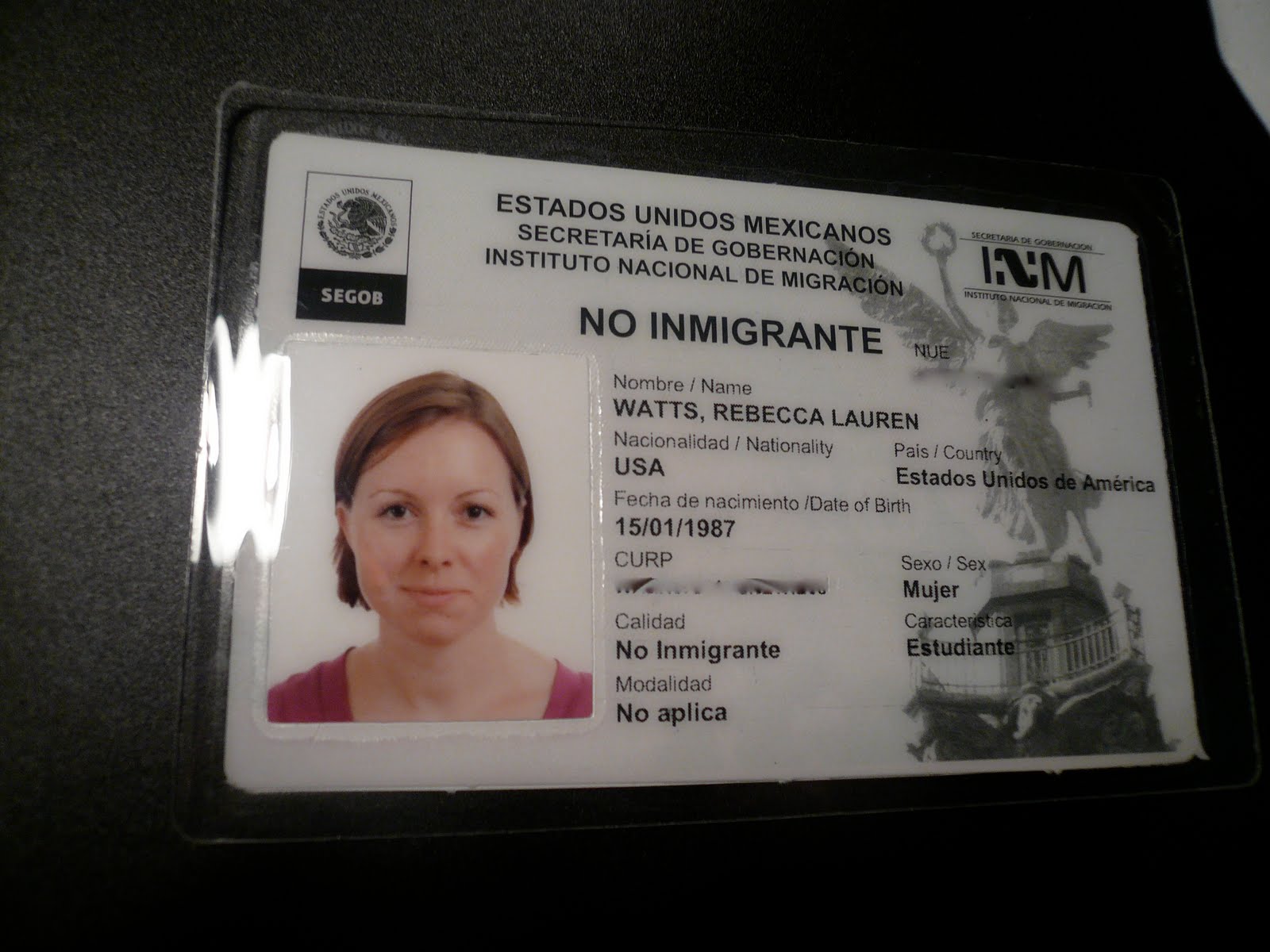
Look, I'm official! With a cool card and everything =)
Subscribe to:
Posts (Atom)


