RECENT POST
Showing posts with label Centro Historico. Show all posts

Friday, February 4, 2011

On my parents' second full day in Mexico we visited the Historic District.

Our first stop was the Zócalo (the main plaza), including the Catedral Metropolitana. My second time seeing the Pope John Paul II statue made out of keys and locks I actually read the sign: it's made out of keys donated by Mexicans because the people of Mexico "gave the keys to their heart" to the Pope (or something along those lines...)

statue of Pope John Paul II

statue of Pope John Paul II

Catedral Metropolitana

From there, we went to visit the Templo Mayor, which was the center of the Aztecs' Tenochtitlan. According to tradition, this is where the god Huitzilopochtli gave the Mexica people his sign that they had reached the promosed land -- an eagle on top of a cactus with a snake in its mouth. It was built sometime around 1325, but was rebuilt six times, alway built on top of the previous construction. What we saw is located just behind the Cathedral -- though the Cathedral is built overtop parts of it. 


disk depicting Coyolxauhqui, painted in what is
thought to be the original colors 

I spy: a lizard


the space between the walls reflects different constructions -- it would
have been filled in to create a newer structure built upon the
older structure 


Chac mool figure 

view of the Cathedral from Templo Mayor


please note the skulls used to "decorate" 


We ate lunch at a restaurant overlooking Templo Mayor and the Zocalo.


Next, we visited the Palacio Nacional (National Palace).


We visited Bellas Artes (the Fine Artes Museum)

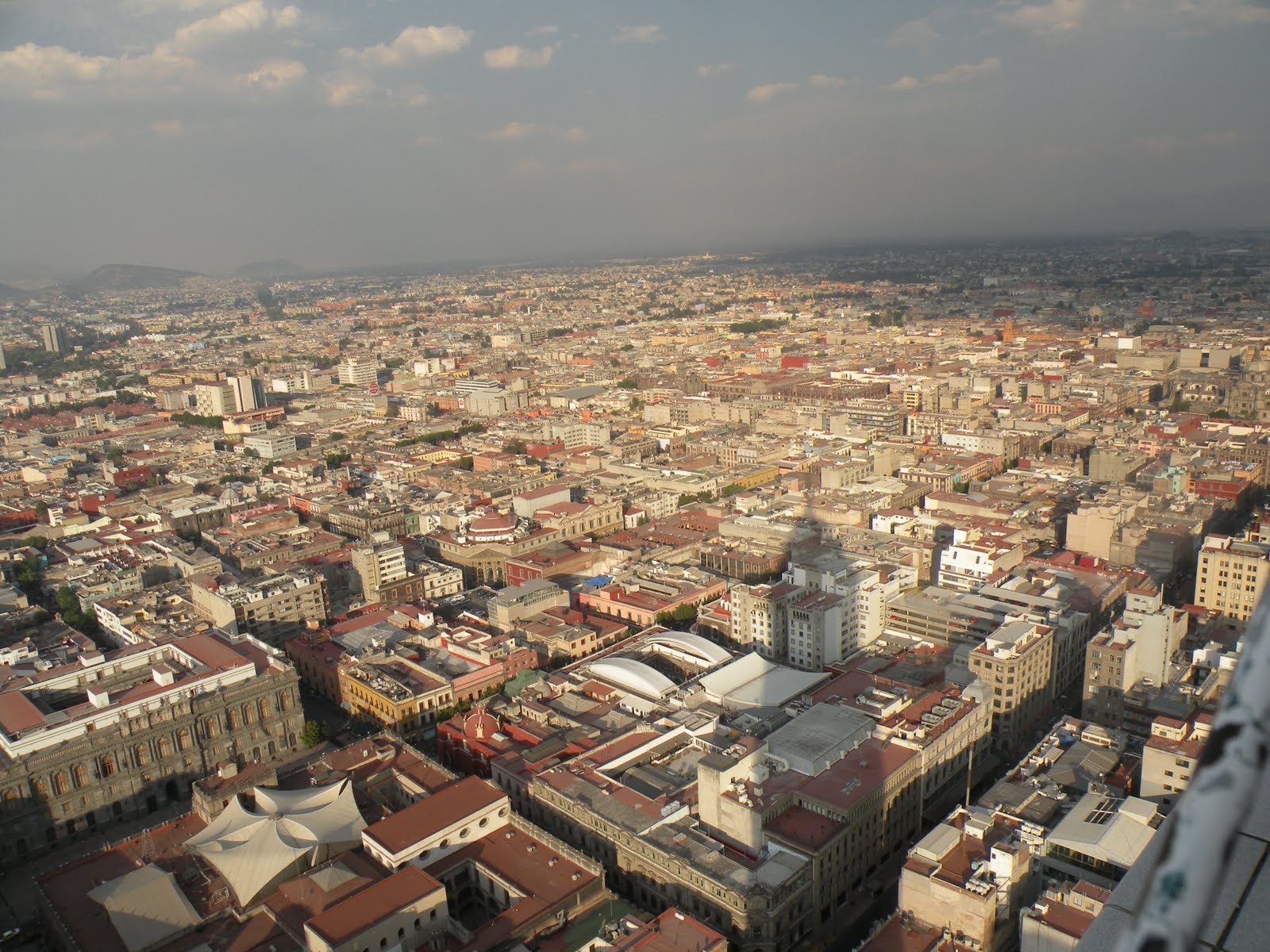
And then we enjoyed the view from the top of the Torre Latinoamericana. The building was the tallest in Mexico from 1956 (when it was built) until 1984. It is apparently the first major skyscraper successfully built on highly active seismic land. The view was incredible! 


You can see the Zócalo in the distance (follow the middle street to
the open plaza) 


Bellas Artes, form above 


We finished our tour of the  Historic District at Café Tacuba -- a cafe that opened in 1912 and had its heydey in the 1950's. A band credited as a pioneering group in the Rock en Español movement took their name from this cafe. I ordered a sweet tamal and atole for my parents to try. Tamales are made of masa (a starchy dough, often corn-based), which is steamed or boiled in a leaf wrapper. They can be filled with meats, cheese, vegetables, chiles, etc. Ours was a sweet tamal, made with pineapple. Atole is a hot drink usually made from masa, water, piloncillo (unrefined cane sugar), cinnamon, vanilla and sometimes chocolate or fruit.


sweet tamal + atole in the background 


Wednesday, August 4, 2010

Saturday was my dad's last day here and since I had finished all of my "chores" for the time being (translations, notary, apartment, UNAM questions answered, etc) we spent the day sightseeing.

We went over to the El Zocalo (which means "base" and is the more common name for the  Plaza de la Constitucion) in the Centro Historico.

On one size of El Zocalo is the Palacio Nacional, which houses the President's office and the Federal Treasury.


Along another side of the Zocalo is the Catedral Metropolitana. It was built on top of the ruins of an Aztec temple and has been sinking unevenly since it was built. 


Outside of the Catedral and Palacio Nacional we saw Aztec healers/cleansers. They had some kind of burning incense and each person to be cleansed had a plant (herbs?) that the healers touched to different parts of their body. We saw various healers throughout the area, but not as large or ornately dressed group as this one. One sign said that it healed anything from headaches to mal de ojo (evil eye) to aura.


Countdown to the bicentennial of Mexico's Independence.


Plaza de Santa Domingo, where printers work beneath the Portal de Evangelistas (as seen in background).


Iglesia de Santo Domingo. 


Former monastery of San Pedro  and San Pablo, now Museo de la Luz.


Templo de Nuestra Senora de Loreto, which started sinking after it was completed in 1816 and now is noticeably crooked. 


Templo de Nuestra Senora de Lorto -- Compare the lines of the street, sides of the building, and door frame. 


Inside the Templo de Nuestra Senora de Loreto.


Plaza outside of the church. The yellow building in the background was the first synagogue in Mexico City. 


Templo Mayor. It is thought to be the spot  where the Aztecs saw the symbolic eagle perched on a cactus with a snake in its beak -- the sign to build the capital (Tenochtitlan) there and today's symbol of Mexico. 


Casa de los Azulejos, built in 1596. 


Moving out of the Centro Historico and into Alameda is the Palacio de Bellas Artes (Palace of Fine Arts), comissioned by President Porifirio Diaz and built between 1905 and 1930.


A stop for lunch in Polanco at Brassi. 


Yum! Chicken stuffed with goat cheese and vegetables, with an orange sauce and pesto. 


Salmon in an orange sauce. 

A cool looking building in Polanco.


Reflecting pool in Parque Rosedal in Polanco -- with remote-controlled boats to rent! 

Parakeets in Parque Rosedal in Polanco. 


Apartments in Polanco. 


Huge flag by the Auditorio Nacional (picture doesn't do it justice!). 


The Auditorio Nacional, where concerts and performances are held. 


Auditorio nacional. 


blogger templates | Make Money Online